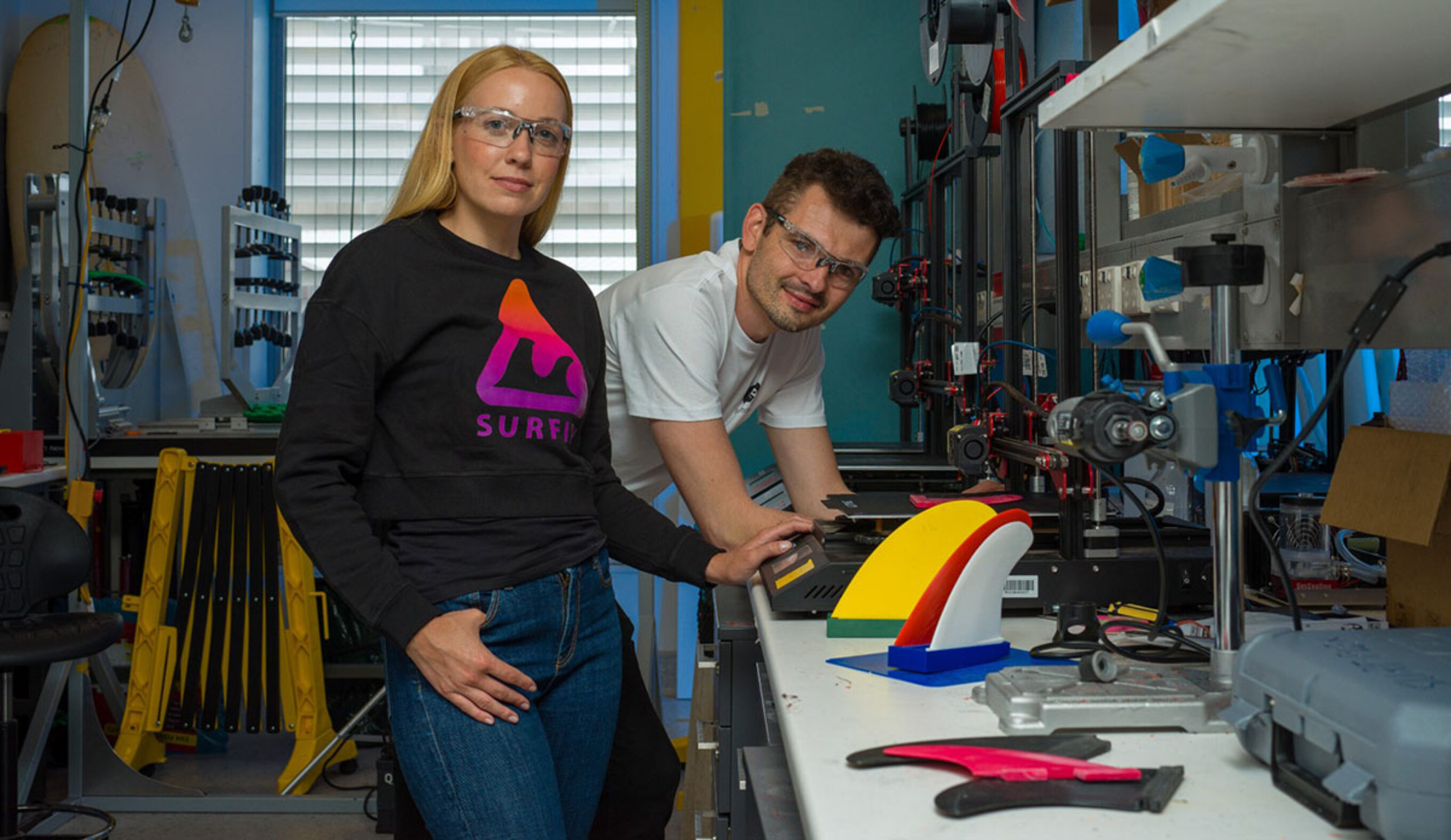
A group of researchers from the Surf Flex Lab, a dedicated surf engineering facility at the University of Wollongong in Australia, is in the process of designing surfboard fins that could deter a shark attack.
“Following a summer of increased shark activity along the New South Wales coast,” a press release explains, “researchers from the University of Wollongong (UOW) are key contributors to a recently launched project developing next generation surfboard fins designed to reduce shark encounters and support safer ocean use for both surfers and marine life.”
The development team, which is funded in part by the Australian Composites Manufacturing Cooperative Research Center (ACM CRC), are building what they call “smart composite fins” that have shark-repellent technologies embedded in them. Those technologies include miniaturized sensors, electromagnetic systems, and illumination features. Of course, maintaining the functionality of the fins is top-of-mind because no one’s going to buy a shark deterring surfboard fin that doesn’t work as a surfboard fin.
“Our focus is on ensuring these new fins perform just as well as traditional designs while incorporating advanced shark-deterrent technologies,” Professor Peter in het Panhuis, the project’s director, said. “Surfers won’t adopt safety innovations if they come at the expense of flex, responsiveness, and maneuverability.”
Shark attacks on the vast Australian coastline are becoming more frequent, likely due to a variety of things: there are more people in the water there than many other places, whale populations are increasing, meaning more food for sharks, and ocean temperatures are rising, which means that species like bull sharks are hanging around longer.
“This is about creating a solution that works in real conditions without compromising on critical board design features,” Panhuis continued. “By combining our expertise in surf engineering with advanced manufacturing techniques, we’re creating a practical way for surfers and sharks to share the ocean more safely.”
Of course, there have been a million-and-one products that claim to deter sharks, but many of them stink of snake oil and promise nothing. The team at Surf Flex Lab plans on running validation tests, as well as conducting performance assessments of the fins.
“The bottom line is that you can spend a lot of money coming up with all these devices,” Dr. Christopher Lowe, a marine biologist and director of the Shark Lab at California State University, Long Beach, told The Inertia in 2016. “It may make you feel more secure when you’re in the ocean, but keep in mind that they may not work 100 percent of the time.”
Still, though, just because creating an effective shark deterrent hasn’t been done yet doesn’t mean people should stop trying, and the researchers at the Surf Flex Lab are all in on figuring it out.
“Innovative composite manufacturing and technology can have life-changing impacts, said ACM CRC CEO Luke Preston. “By embedding functional technologies into lightweight, composite materials we can support both innovation and practical application, delivering the next generation of surfboards at a time when shark attacks are apparently on the rise. This is a world first that is strengthening the capabilities and resilience of Australian surfboard manufacturing, giving us a competitive edge in a crowded global market.”