Buzzy Kerbox at Haleiwa, 1976
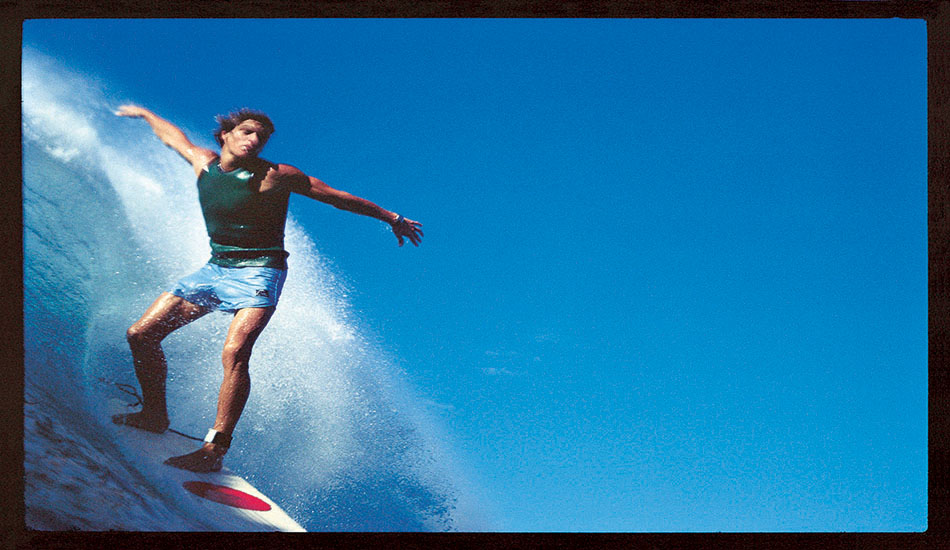
Shooting pictures with the little Nikonos water camera was something of a hit-and-miss affair. The early models had a 35 mm lens that meant you had to get very close to what was happening … otherwise it looked like it was the length of a football field away. You really had to swim, being on a surf mat or a board didn’t cut it. Wave knowledge and surfing experience were essential. I dropped one of the cameras and lost it, and then tethered its replacement to my wrist. I often simply held it out, pointed in what I hoped was the right direction, and pressed the shutter. This picture of Buzzy Kerbox at Haleiwa is an example of that. You probably wouldn’t try for the odd composition, but it’s a favorite image of mine.
I started taking surfing pictures in the very early 1960s because it looked pretty easy. I started contributing to surfing magazines in Australia around the same time for much the same reason — oh, and because the general standard of contributions was abysmal. It wasn’t very hard to look half-competent.
I was influenced by the dramatic use of photographs in the quality general-interest European magazines at the time and, more specifically, by the great editor of the California-based magazine Surf Guide, Bill Cleary. Between 1966 and 1970, I worked for Surfing World, Surf International, co-founded Tracks in Australia, and contributed irregularly to the major U.S. surfing magazines. I snuck into the (self-appointed) role of opinionated chronicler of the times by editing, writing, and taking pictures.
Most of these pictures have lain undisturbed, by everyone including me, for nearly 40 years. I’m not quite sure why there is a renewed interest in them — and it’s quite a surprise. Certainly these days the pictures are being viewed through a social documentary prism; they have attracted attention from far beyond the tiny world of surfing for which they were originally shot.
Purchase A Golden Age: Surfing’s Revolutionary 1960s and ’70s here.