Cactus
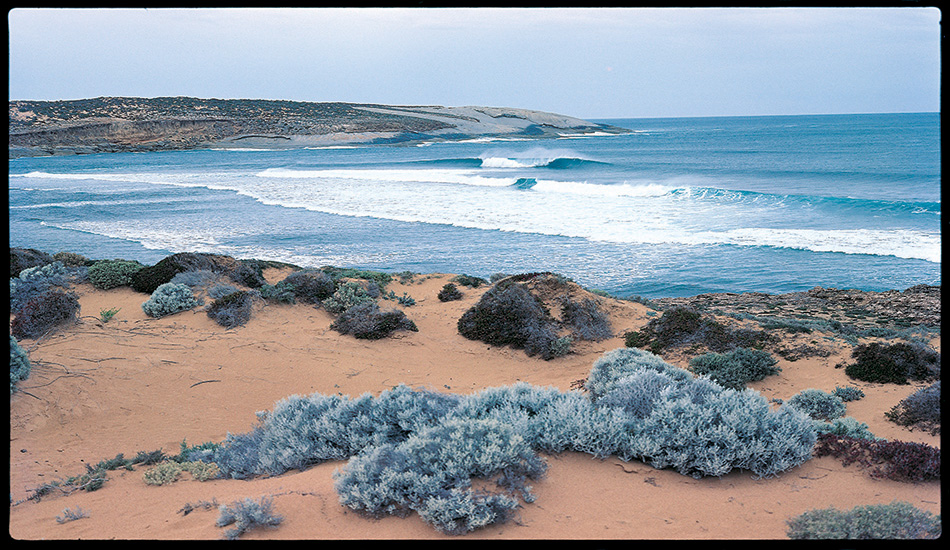
‘Cactus’ (its actual name is Point Sinclair) is west of Ceduna in South Australia. It’s on the coast south of Penong, the last town when you’re heading west across the Nullabor Plain. It’s always been a wild place. It’s isolated, but attracted fishermen and surfers from at least the 1950s. In the early ’60s it was ‘discovered’ by Adelaide surfers and then fiercely protected as a ‘secret spot’. This is what it looks like when the wind and the swell have got their acts together. This break was called ‘Witzigs’ because it was next to a house my brother built. Despite some historical revisionism since, it’s still called that.
I started taking surfing pictures in the very early 1960s because it looked pretty easy. I started contributing to surfing magazines in Australia around the same time for much the same reason — oh, and because the general standard of contributions was abysmal. It wasn’t very hard to look half-competent.
I was influenced by the dramatic use of photographs in the quality general-interest European magazines at the time and, more specifically, by the great editor of the California-based magazine Surf Guide, Bill Cleary. Between 1966 and 1970, I worked for Surfing World, Surf International, co-founded Tracks in Australia, and contributed irregularly to the major U.S. surfing magazines. I snuck into the (self-appointed) role of opinionated chronicler of the times by editing, writing, and taking pictures.
Most of these pictures have lain undisturbed, by everyone including me, for nearly 40 years. I’m not quite sure why there is a renewed interest in them — and it’s quite a surprise. Certainly these days the pictures are being viewed through a social documentary prism; they have attracted attention from far beyond the tiny world of surfing for which they were originally shot.
Purchase A Golden Age: Surfing’s Revolutionary 1960s and ’70s here.